
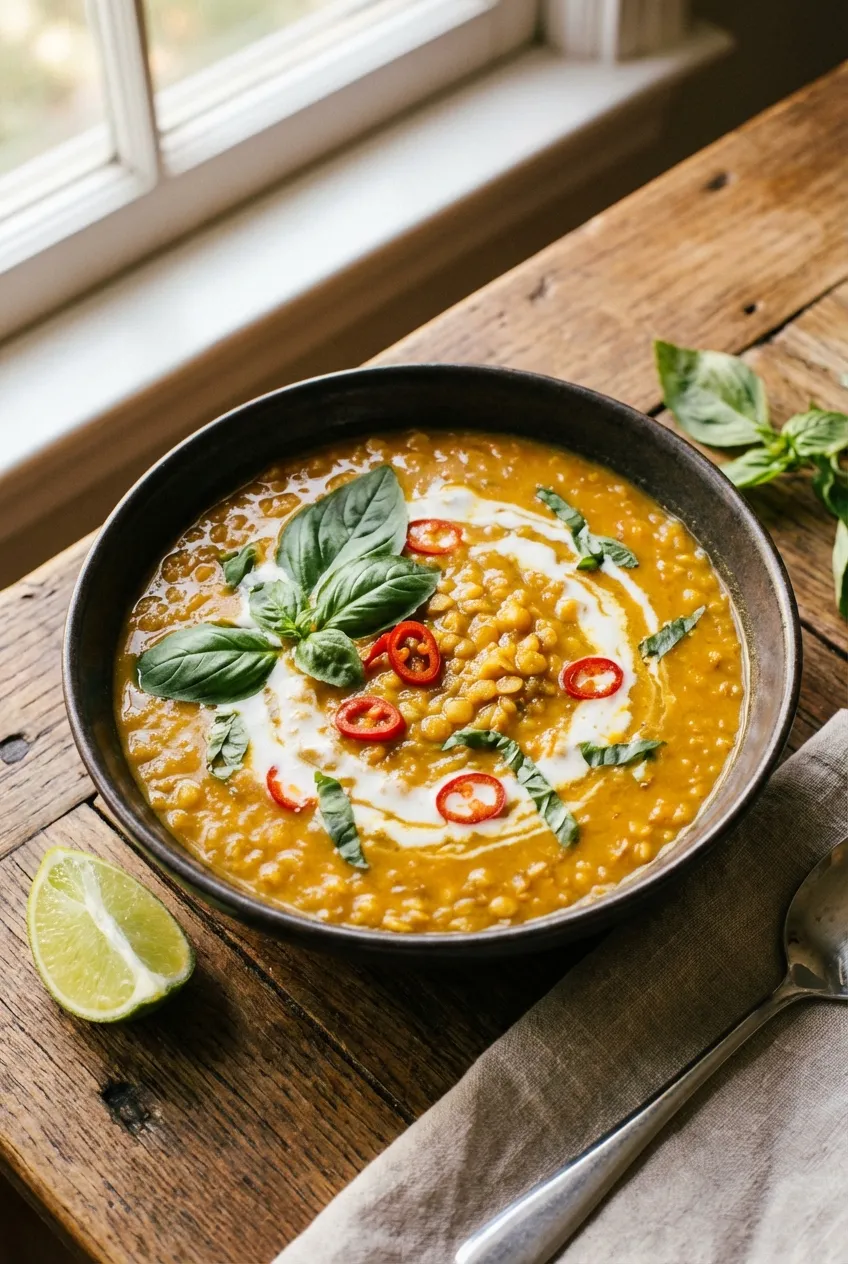
The Story Behind This Recipe
There is a dal my mother made every single week when I was growing up in Mumbai — a simple red lentil preparation seasoned with turmeric, cumin, and a generous tadka of mustard seeds and curry leaves sizzling in ghee. It was the most unremarkable dish on our table and also the most essential. No matter what else was being served, that dal was there, steady and warm and grounding. I did not appreciate it until I left home.
When I was studying nutrition at Cornell, the winters hit me like nothing I had experienced. I remember standing in the international aisle of a small grocery store in Ithaca, shivering, homesick, and staring at a jar of Thai red curry paste. I had never used it before — Thai food was not part of my cooking vocabulary at that point — but something about the color and the promise of warmth drew me in. That evening, in my tiny apartment kitchen, I made my mother’s red lentil dal but stirred in two tablespoons of red curry paste and a can of coconut milk instead of the water and ghee she would have used. It was a completely different dish and yet it was also exactly the same — warm, nourishing, and deeply comforting.
Over the years at the Natural Gourmet Institute in New York and in my practice as a nutritionist, I refined this recipe into something I am genuinely proud of. Red lentils are one of nature’s most perfect foods: packed with protein and fiber, they cook in under 20 minutes, and they break down into a naturally creamy, velvety base that needs no dairy to feel rich. The Thai curry paste brings a complex heat — lemongrass, galangal, chili — that layers beautifully with the earthy lentils and the sweet richness of coconut milk. A squeeze of lime at the end ties everything together with a brightness that makes you want to go back for another spoonful, and then another, and then one more. This is the soup I make when I need to feel taken care of. It has never let me down.
Before You Start
- Rinse the lentils thoroughly. Place them in a fine-mesh strainer and run cold water over them until the water runs clear. This removes surface starch and any grit, resulting in a cleaner-tasting, less foamy soup.
- Check your curry paste for vegan ingredients. Most Thai red curry pastes are vegan, but some brands include shrimp paste. Mae Ploy, Thai Kitchen, and Mekhala all make vegan versions. Check the label.
- Use full-fat coconut milk. Light coconut milk will make the soup thinner and less satisfying. Shake the can well before opening to combine the cream and liquid.
- Have lime juice and basil ready for finishing. These are added off the heat and make a dramatic difference in the final flavor. Do not skip them.
Instructions
Step 1: Build the Aromatic Base
Heat the coconut oil in a large Dutch oven or heavy-bottomed pot over medium heat. Add the diced onion and cook, stirring occasionally, for 4 to 5 minutes until softened and translucent. The onion should be gently sizzling, not aggressively browning.
Add the minced garlic and grated ginger and stir constantly for 60 seconds until intensely fragrant. You will smell the ginger sharpen and the garlic mellow as they hit the hot oil.
Add the Thai red curry paste and stir it into the aromatics for 1 to 2 minutes. The paste will darken slightly and become extremely aromatic as the oils release the flavors of the lemongrass, galangal, and chili. If it sticks, add a splash of broth. The kitchen should smell incredible at this point.
Step 2: Toast the Spices and Add Lentils
Add the turmeric and cumin to the pot and stir for 30 seconds to bloom the spices — they should release a warm, earthy aroma. This step transforms raw-tasting ground spices into something deep and toasty.
Add the rinsed red lentils and stir to coat them in the aromatic base. Let them toast with the spices for 1 minute, stirring constantly. This brief toasting step adds a subtle nutty dimension to the finished soup.
Step 3: Simmer the Soup
Pour in the vegetable broth, diced tomatoes (with their juices), soy sauce, and maple syrup. Stir well and bring to a boil over high heat. You will notice foam forming on the surface — skim it off with a spoon for a cleaner soup, or simply stir it in.
Reduce heat to medium-low, partially cover the pot, and simmer for 18 to 20 minutes, stirring every 5 minutes or so to prevent the lentils from sticking to the bottom. The lentils are done when they have broken down almost completely into a thick, creamy consistency — you should see some whole lentils remaining, but most will have dissolved into the broth, creating a naturally velvety texture.
Step 4: Add the Coconut Milk
Pour in the full can of coconut milk and stir until the soup transforms from orange-gold to a rich, creamy golden color. Simmer for 3 to 4 minutes more to let the coconut milk heat through and integrate.
If you are adding spinach or kale, stir it in now. Spinach will wilt in 1 to 2 minutes. Kale needs 3 to 4 minutes — stir it in earlier and let it soften fully.
Step 5: Season and Finish
Remove the pot from the heat. Stir in the fresh lime juice — taste the soup before and after to appreciate how dramatically the lime brightens and balances the rich, spicy, coconut flavors.
Taste and adjust: more curry paste for heat, more lime for brightness, more soy sauce for saltiness, more maple for sweetness, salt and pepper to finish. The soup should be warmly spiced, creamy, slightly tangy, and deeply satisfying.
Step 6: Serve
Ladle the soup into deep bowls. Drizzle each serving with coconut cream in a swirl pattern. Top with fresh Thai basil (or regular basil), sliced red chili, and a lime wedge on the side.
Serve with steamed jasmine rice for a heartier meal (spoon the rice directly into the soup) or with warm crusty bread for dipping. This soup is a meal on its own but welcomes the company.
Ingredient Substitutions
| Ingredient | Substitute | Notes |
|---|---|---|
| Red lentils | Yellow lentils or split peas | Yellow lentils cook similarly. Split peas need 30 to 35 minutes and produce a denser soup. |
| Thai red curry paste | Green curry paste or 1 tablespoon curry powder + 1 teaspoon chili flakes | Green curry paste is slightly more herbal. Curry powder changes the flavor profile significantly but still works. |
| Coconut milk | Cashew cream or full-fat oat milk | Less tropical flavor. Cashew cream is richer and closer to coconut milk’s body. |
| Fresh ginger | 1/2 teaspoon ground ginger | Fresh is far superior. Ground ginger is sharper and more one-dimensional. |
| Thai basil | Regular sweet basil or cilantro | Thai basil has an anise note. Sweet basil is milder. Cilantro takes it in a different (good) direction. |
| Diced tomatoes | 2 large fresh tomatoes, chopped | Fresh tomatoes are less acidic. You may need less maple syrup. |
| Spinach | Kale, Swiss chard, or omit entirely | Kale adds 2 to 3 minutes of cook time. The soup is excellent without greens. |
| Soy sauce | Coconut aminos or extra salt | Soy sauce adds umami depth beyond just saltiness. Coconut aminos is sweeter. |
Chef’s Tips
- Bloom the curry paste properly. Cooking the curry paste in oil for 1 to 2 minutes before adding liquid is the most important technique in this recipe. Raw curry paste tastes flat and one-dimensional. Bloomed paste tastes complex, fragrant, and properly Thai.
- Red lentils are self-thickening. Unlike other legumes, red lentils break down as they cook and create their own creamy texture without any blending. If you want a smoother soup, cook 5 minutes longer. If you prefer more texture, cook 5 minutes less.
- The lime juice is not optional. I cannot stress this enough. Lime juice is the ingredient that transforms this from a good soup into a great one. The acid balances the richness of the coconut milk and the heat of the curry paste. Add it off the heat to preserve its brightness.
- Make it spicier gradually. Start with 2 tablespoons of curry paste and taste after simmering. You can always stir in more paste, but you cannot take it away. Different brands vary wildly in heat level.
- Day-two soup is the best soup. Like most lentil soups, this thickens and improves overnight as the flavors meld. Add a splash of broth or water when reheating to thin it back to your preferred consistency.
- Freeze in individual portions. This soup freezes beautifully. Portion into single-serve containers for grab-and-go lunches that are infinitely better than anything from a can.
Meal Prep & Storage
- Refrigerator storage: Store in an airtight container for up to 5 days. The soup thickens significantly as it cools — this is normal and is caused by the lentils continuing to absorb liquid. Thin with broth or water when reheating.
- Freezer storage: Freeze in portioned containers for up to 3 months. Let cool completely before freezing. Thaw overnight in the fridge or reheat from frozen over low heat, stirring frequently.
- Reheating: Warm on the stovetop over medium-low heat, adding 1/4 cup of broth or water per serving to restore the original consistency. Stir frequently to prevent sticking. Add fresh lime juice and basil after reheating — the brightness fades during storage.
- Batch cooking: This recipe doubles or triples easily with no timing adjustments. Use a large stockpot and increase the simmer time by 5 minutes.
- Meal prep tip: Store the soup and rice separately. Add fresh garnishes (basil, chili, lime, coconut cream) each time you serve for maximum freshness.
Pairing Suggestions
- Rice: Steamed jasmine rice is the classic pairing. Spoon it directly into the soup for a more substantial meal, or serve alongside for dipping.
- Bread: Warm naan, roti, or crusty sourdough for dipping. The bread soaks up the creamy broth beautifully.
- Side: A crunchy Thai-inspired cucumber salad with rice vinegar, sesame oil, chili flakes, and toasted sesame seeds. The cool crunch contrasts the warm, rich soup perfectly.
- Drink: A cold Thai iced tea (use plant milk), sparkling water with lime, or a light lager. The sweetness of Thai iced tea complements the spice level nicely.
Frequently Asked Questions
How spicy is this soup? With 2 tablespoons of red curry paste, it has a medium warmth — noticeable heat that builds gently but does not overpower. For mild, use 1 1/2 tablespoons. For spicy, go to 3 tablespoons. The coconut milk tempers the heat significantly, so even the spicier version is approachable for most palates.
Do I need to soak the lentils before cooking? No. Red lentils are split and hulled, which means they cook very quickly without soaking — typically 18 to 20 minutes. Just rinse them in a fine-mesh strainer until the water runs clear. This is one of the reasons red lentils are perfect for fast weeknight cooking.
Can I use brown or green lentils instead? You can, but the result will be very different. Brown and green lentils hold their shape and do not break down into a creamy soup. You would end up with a brothy stew rather than a velvety soup. If you use them, increase the cook time to 35 to 40 minutes and consider blending half the soup for creaminess.
My soup is too thick. What do I do? Add vegetable broth or water, a quarter cup at a time, until you reach your preferred consistency. Red lentils absorb liquid aggressively, especially as the soup cools. This is completely normal and expected — just thin it out.
Is this soup high in protein? Yes. One serving provides approximately 18 grams of protein from the lentils and coconut milk combined. Red lentils are one of the most protein-dense plant foods available. Pair with rice for a complete amino acid profile.
Can I make this in an Instant Pot? Yes. Use the saute function for steps 1 and 2. Add all the remaining ingredients except the coconut milk, lime juice, and spinach. Pressure cook on high for 10 minutes with a natural release. Stir in the coconut milk, lime juice, and spinach after opening the lid. Adjust the consistency with broth as needed.