
The Story Behind This Recipe
Katsu curry was the first dish that made me fall in love with Japanese comfort food. I was nineteen, fresh off a plane in Tokyo for a stage at Narisawa, and completely overwhelmed. My Japanese was terrible, the kitchen was the most disciplined environment I had ever been in, and I was homesick for my family’s restaurant in Chinatown. The one thing that grounded me was a tiny katsu shop near my apartment in Shinjuku — a counter with eight seats, run by an elderly couple who had been making the same curry since the 1970s.
Their version was classic: golden pork cutlet, thick curry sauce ladled on the side, a mound of rice, and a tiny pile of pickled ginger. I ate there three or four times a week. The curry was unlike anything I had grown up with in Cantonese cooking — sweeter, milder, almost velvety, with a warmth that built slowly instead of hitting you all at once. I started studying how they made it: slow-cooked onions forming the base, a blend of curry powder and garam masala, carrots that melted into the sauce to give it body, and a touch of sweetness that tied everything together.
When I came back to San Francisco and started developing recipes that worked for every eater at my table — including friends and family who did not eat meat — tofu became my go-to for katsu. The trick is pressing it properly, getting the panko coating shatteringly crispy, and building the curry sauce with enough depth that you forget there is no meat involved. This recipe is my tribute to that tiny shop in Shinjuku. The old man who ran it told me once that the secret to good katsu is not the cutlet — it is the sauce. After fifteen years of making this, I believe him completely.
Before You Start
- Press the tofu thoroughly. Wrap the block in a clean kitchen towel or several layers of paper towels, place it on a plate, and set something heavy on top (a cast iron skillet works perfectly). Press for at least 20 minutes. Dry tofu = crispy coating. Wet tofu = soggy disaster.
- Start the curry sauce first. The sauce takes about 20 minutes and improves as it simmers. Get it going before you bread and fry the tofu.
- Use Japanese curry powder if you can find it. S&B brand curry powder (the one in the red can) has a distinctive sweetness and warmth that is different from Indian curry powder. It is available at most Asian grocery stores and online. Regular curry powder works but the flavor will be slightly different.
- Set up a breading station. Three shallow dishes in a row: flour, plant milk mixture, and panko. This assembly line makes the coating process fast and clean.
Instructions
Step 1: Start the Curry Sauce
Heat 1 tablespoon of neutral oil in a medium saucepan over medium heat. Add the diced onion and cook, stirring occasionally, for 8 to 10 minutes until deeply golden and soft. The onions should be caramelized at the edges — this is where the sweetness of Japanese curry comes from. Do not rush this step.
Add the diced carrots and cook for 3 minutes, stirring occasionally. Add the minced garlic and grated ginger and stir for 30 seconds until fragrant.
Add the curry powder, garam masala, and turmeric. Stir constantly for 45 seconds to bloom the spices — the mixture will become very aromatic and darken slightly.
Stir in the tomato paste, soy sauce, and maple syrup. Pour in the vegetable broth and bring to a simmer. Reduce heat to medium-low and let the sauce simmer for 15 minutes, stirring occasionally, until the carrots are completely tender.
Step 2: Thicken and Blend the Sauce
For a smooth sauce (traditional style), use an immersion blender to blend the sauce directly in the pot until silky, or transfer to a blender and blend until smooth, then return to the pot. For a chunkier sauce, blend only half and stir it back in.
Stir the cornstarch slurry into the sauce and cook for 2 minutes more, stirring constantly, until the sauce thickens to a gravy-like consistency that coats the back of a spoon. Taste and adjust — more soy for saltiness, more maple for sweetness, more curry powder for depth. Keep warm on the lowest heat setting with a lid on.
Step 3: Bread the Tofu
Slice the pressed tofu block horizontally into 4 even cutlets, each about 3/4-inch thick. Pat each cutlet dry one more time with paper towels.
Set up your breading station: place the flour in one shallow dish; whisk together the plant milk, soy sauce, garlic powder, and black pepper in a second dish; spread the panko in a third dish.
Dredge each tofu cutlet in flour, shaking off the excess. Dip into the plant milk mixture, letting the excess drip off. Press firmly into the panko, turning to coat all sides and edges. Press the panko onto the surface so it adheres — really pack it on. Set the breaded cutlets on a plate.
Step 4: Fry the Katsu
Heat 1/4 cup of neutral oil in a large skillet over medium heat until a breadcrumb sizzles immediately when dropped in (about 350°F / 175°C). The oil should be about 1/4-inch deep — you are shallow-frying, not deep-frying.
Carefully place 2 cutlets in the oil (do not crowd — fry in batches). Cook for 3 to 4 minutes per side until the panko is deep golden brown and shatteringly crispy. The coating should be uniform and audibly crunchy when you tap it with tongs. Transfer to a wire rack set over a sheet pan (not paper towels — the steam will soften the bottom). Sprinkle with a tiny pinch of salt immediately. Repeat with remaining cutlets.
Step 5: Slice and Assemble
Let the katsu cutlets rest for 2 minutes — this allows the coating to set. Using a sharp knife, slice each cutlet crosswise into 3/4-inch strips, keeping them together so the cutlet holds its shape.
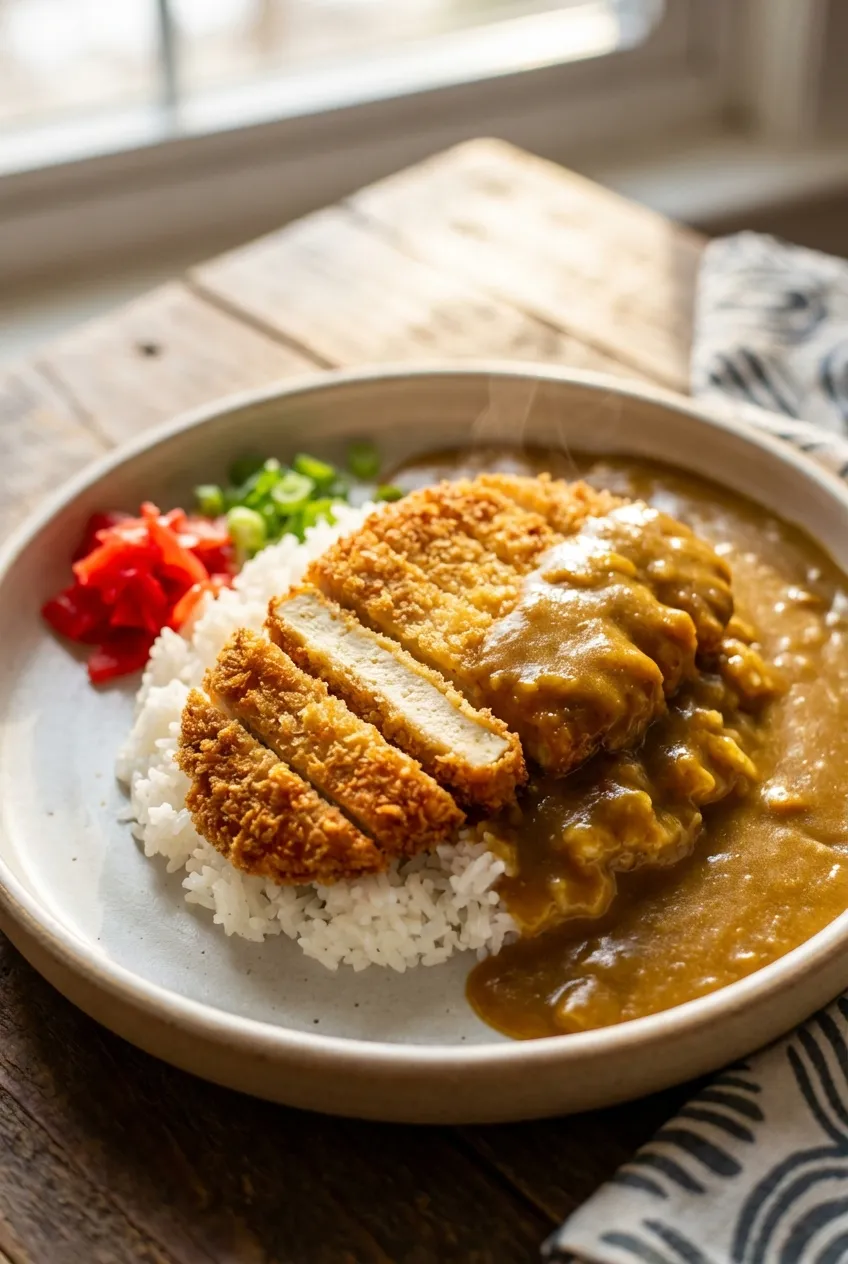
Scoop a generous mound of hot rice onto each plate. Lean the sliced katsu cutlet against the rice. Ladle the warm curry sauce alongside — not over the top of the katsu, to keep the crust crispy. Garnish with pickled ginger and sliced green onions.
Step 6: Serve
Serve immediately. The beauty of katsu curry is the contrast between the crispy, crunchy coating and the smooth, rich sauce — so let each person dip or pour as they eat. Provide extra sauce on the side for those who want to drown their rice (no judgment).
Ingredient Substitutions
| Ingredient | Substitute | Notes |
|---|---|---|
| Extra-firm tofu | Thick-sliced tempeh or cauliflower steaks | Tempeh needs no pressing. Cauliflower steaks: slice 3/4-inch thick, steam for 5 min before breading. |
| Panko breadcrumbs | Crushed cornflakes or regular breadcrumbs | Panko gives the best crunch. Cornflakes are a surprisingly good alternative. Ensure they are vegan. |
| Japanese curry powder | Regular curry powder + pinch of cinnamon | The cinnamon mimics the sweeter, warmer Japanese curry profile. |
| Plant milk | Aquafaba (chickpea liquid) | Aquafaba creates an even crispier coating due to its binding properties. Use straight from the can. |
| Mirin | Maple syrup or rice vinegar + sugar | Mirin adds subtle sweetness. 1 teaspoon sugar + 1 teaspoon rice vinegar approximates it. |
| Cornstarch | Arrowroot powder | Same thickening power. Use the same amount. |
| Short-grain rice | Basmati or jasmine rice | Short-grain is traditional and stickier. Long-grain works fine flavor-wise. |
Chef’s Tips
- Double-press for maximum crunch. After the initial 20-minute press, wrap the tofu in fresh towels and press for another 10 minutes. The drier the tofu, the crispier the finished katsu. It is worth the extra time.
- Toast the panko before breading. Spread the panko on a dry sheet pan and toast at 350°F (175°C) for 3 to 4 minutes until lightly golden. Pre-toasted panko fries up even crunchier and more evenly golden.
- Keep the oil temperature steady. If the oil is too hot, the panko burns before the tofu heats through. Too cool and the coating absorbs oil and becomes greasy. Drop a breadcrumb in — it should sizzle gently, not violently.
- Make extra sauce and freeze it. The curry sauce freezes beautifully for up to 3 months. Thaw and reheat for instant katsu nights — just fry the tofu and you are done in 15 minutes.
- Sauce on the side, not on top. Pour the curry sauce next to the katsu, not over it. This preserves the crispy coating. Each bite should be a deliberate dip.
- Use a wire rack, not paper towels. Paper towels trap steam against the bottom of the katsu, making it soggy. A wire rack lets air circulate on all sides.
Meal Prep & Storage
- Curry sauce storage: Refrigerate in an airtight container for up to 5 days or freeze for up to 3 months. The sauce actually improves overnight.
- Breaded tofu storage: Bread the cutlets up to 4 hours ahead and refrigerate uncovered on a wire rack. Fry just before serving for maximum crunch.
- Leftover katsu: Store fried katsu in the fridge for up to 2 days. Reheat in the oven at 400°F (200°C) for 8 to 10 minutes to re-crisp. Do not microwave — it will become soft.
- Freezing fried katsu: Freeze individually on a sheet pan, then transfer to a freezer bag. Reheat from frozen at 400°F (200°C) for 12 to 15 minutes.
- Rice prep: Cook rice ahead and refrigerate for up to 3 days. Reheat with a splash of water, covered, in the microwave.
Pairing Suggestions
- Side: A simple cucumber and wakame salad dressed with rice vinegar, sesame oil, and a sprinkle of sesame seeds. The cool acidity cuts through the richness perfectly.
- Drink: Cold Japanese green tea, a crisp lager like Asahi or Sapporo, or a chilled sake complement the warm, savory flavors of the curry.
- Pickles: Japanese pickled vegetables (tsukemono) — especially pickled daikon radish or cucumber — add brightness and crunch to the plate.
- Soup: A simple miso soup with silken tofu and wakame seaweed makes this feel like a complete Japanese set meal (teishoku).
Frequently Asked Questions
How do I press tofu if I do not have a tofu press? Wrap the block in a clean kitchen towel or several layers of paper towels. Place it on a cutting board, set a plate on top, and stack something heavy on the plate — a cast iron skillet, a few cans, or a heavy cookbook. Let it sit for at least 20 minutes. Drain the liquid that pools around it.
Can I bake the katsu instead of frying? Yes, though the texture will be slightly different. Brush or spray the breaded cutlets with oil on all sides. Bake at 425°F (220°C) on a wire rack set over a sheet pan for 20 to 25 minutes, flipping once halfway through, until golden and crispy. The result is lighter and less crunchy than fried but still delicious.
What makes Japanese curry different from Indian curry? Japanese curry is milder, sweeter, and thicker — more like a rich gravy than a saucy stew. It was adapted from British naval curry in the late 1800s and evolved into its own distinct cuisine. The flavor profile leans toward warm spices, caramelized onions, and a subtle fruitiness rather than the bold, complex heat of Indian curries.
Can I use store-bought Japanese curry blocks? Absolutely. Brands like S&B Golden Curry and Vermont Curry make vegan-friendly blocks (check the label — some contain dairy). Dissolve them in broth according to the package directions. The homemade sauce in this recipe has more depth, but the blocks are a perfectly valid shortcut for busy nights.
My panko coating fell off during frying. What happened? Usually this means the tofu was not dry enough, or the flour step was skipped. The flour creates a dry surface for the wet mixture to adhere to, and the wet mixture acts as glue for the panko. Press the panko firmly onto the surface and handle the breaded cutlets gently. Also make sure the oil is at the right temperature before adding the tofu — cold oil can cause the coating to slide off.
Is this recipe gluten-free? As written, no — panko breadcrumbs and flour contain gluten. For a gluten-free version, use rice flour instead of all-purpose flour and gluten-free panko breadcrumbs (widely available). Use tamari instead of soy sauce.