
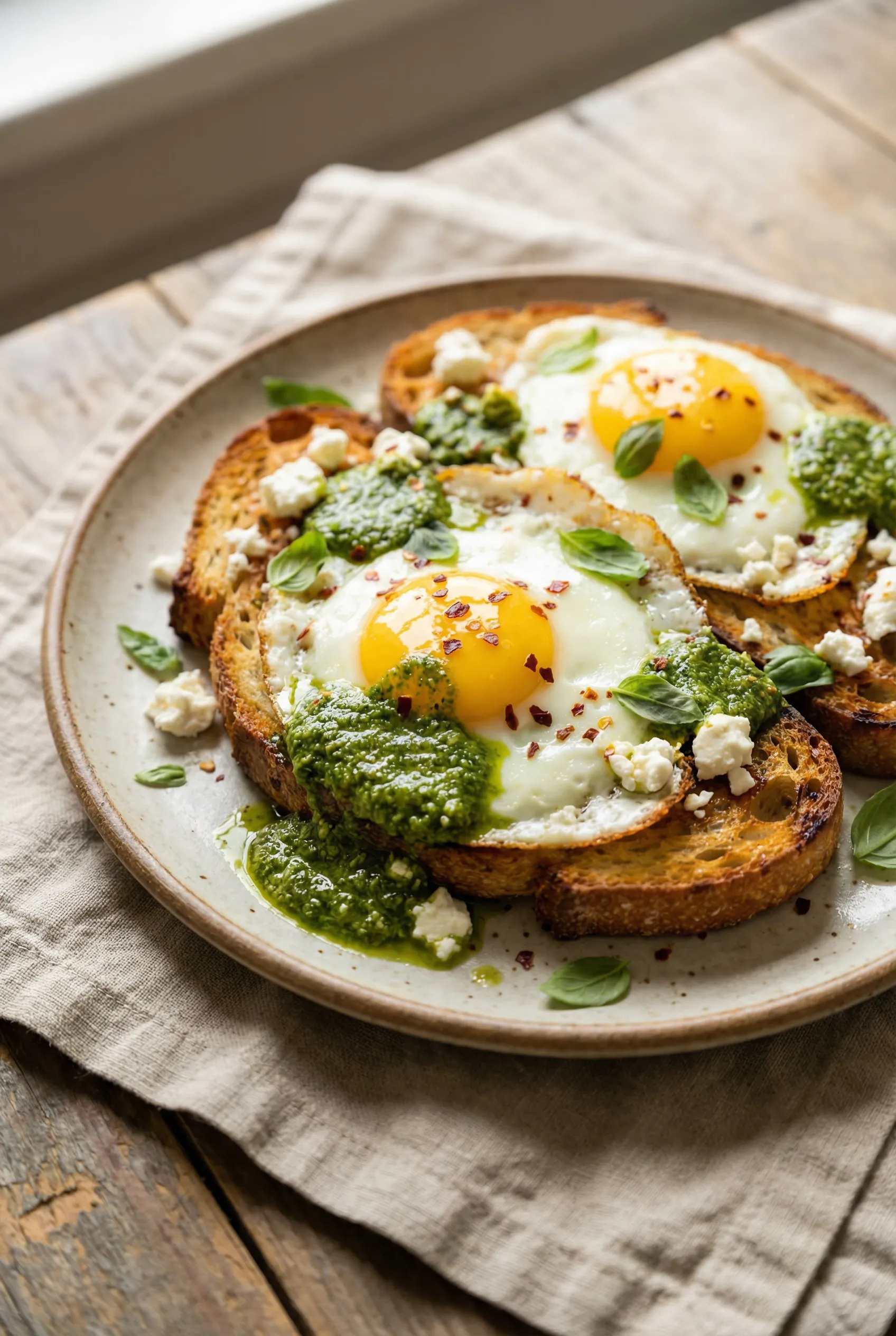
The Story Behind This Recipe
I first encountered the idea of cooking eggs in pesto on a tiny screen — my daughter showed me a TikTok video while we were visiting family in Lisbon, and I nearly dropped my espresso. Not because the concept was revolutionary, but because it was so obviously right that I could not believe I had not thought of it myself. I have been frying eggs in olive oil my entire life. My grandmother in coastal Portugal would crack eggs into pools of garlicky olive oil and let the edges go lacy and golden while the yolks stayed soft as silk. The idea of replacing that oil with pesto — a sauce I already build from olive oil, garlic, basil, and Parmesan — felt like the most natural evolution imaginable.
I went straight to my mother’s kitchen, pulled a jar of her homemade pesto from the refrigerator, and fried two eggs in it right there. The basil oil sizzled and perfumed the whole room, the Parmesan in the pesto formed these tiny crispy bits around the egg whites, and when I slid them onto a piece of toasted sourdough with crumbled feta and a crack of black pepper, my mother took one bite and said, “Why didn’t we always do this?” That is exactly the question. Some recipes feel like they have always existed — they were just waiting for someone to put the pieces together.
I have since made this hundreds of times, and I have refined the technique to get the edges perfectly crispy while keeping the yolk completely runny. The secret is a nonstick pan over medium-low heat, patience, and good pesto. I use my own with plenty of basil, toasted pine nuts, and real Parmigiano-Reggiano, but a quality store-bought jar works beautifully on a busy morning. The sourdough must be thick-cut and toasted until truly crunchy — it needs to stand up to the runny yolk without going soggy. This is the breakfast I make every single weekend now, and it comes together in under fifteen minutes.
Before You Start
- Use a good nonstick pan. Pesto sticks more aggressively than plain oil because of the cheese and nut solids. A reliable nonstick skillet prevents the egg whites from tearing when you slide them out.
- Bring your eggs to room temperature. Cold eggs dropped into warm pesto will lower the pan temperature and cook unevenly. Pull them from the fridge 10 minutes before cooking or run them under warm water for 30 seconds.
- Toast the sourdough properly. A soft, floppy piece of toast will collapse under the weight of a runny yolk. Toast until deeply golden and crisp all the way through — a toaster oven or broiler works better than a standard toaster for thick slices.
- Have everything ready before you start. These eggs cook in about 3 minutes. Slice the avocado, crumble the feta, and have your toast ready before the pesto hits the pan.
Instructions
Step 1: Toast the Sourdough
Place sourdough slices directly on the rack of a toaster oven or under a broiler set to high. Toast for 2-3 minutes per side until deeply golden brown and crisp throughout. You want an audible crunch when you press the surface. Remove and immediately rub one side with a drizzle of olive oil. Set aside on serving plates.
Step 2: Heat the Pesto
Set a 10-inch nonstick skillet over medium-low heat. Add the pesto and spread it into an even layer across the bottom of the pan using a spatula. Let it warm for 45-60 seconds until the pesto begins to gently bubble around the edges and the kitchen fills with the aroma of warm basil and garlic. You should see tiny bubbles forming — not aggressive sputtering.
Step 3: Crack the Eggs
Crack eggs directly into the pesto, spacing them so the whites do not overlap. Season immediately with flaky sea salt and black pepper. Reduce heat to low if the pesto is bubbling aggressively. The goal is a gentle, steady sizzle — too much heat will burn the Parmesan solids in the pesto and turn them bitter.
Step 4: Cook Low and Slow
Let the eggs cook undisturbed for 3-4 minutes. The whites will set from the bottom up while the yolks stay jiggly and runny. Watch the edges — you want them to turn slightly golden and lacy where the pesto oil fries the egg white. If the tops of the whites are still translucent after 3 minutes, cover the pan with a lid for 30-45 seconds to steam them set. Do not flip the eggs.
Step 5: Assemble the Toast
Spread butter across each piece of toasted sourdough while they are still warm — it should melt on contact. If using avocado, fan the slices across the toast now. Using a thin spatula, carefully slide two pesto eggs onto each piece of toast, scooping up any extra pesto from the pan and spooning it over the top.
Step 6: Garnish and Serve
Scatter crumbled feta over the eggs. Add red pepper flakes, a few torn basil leaves, and toasted pine nuts if using. Finish with one more pinch of flaky sea salt. Serve immediately — the yolk should break and run into the toast when you cut into it. That golden, green-flecked stream is the entire point of this dish.
Ingredient Substitutions
| Ingredient | Substitute | Notes |
|---|---|---|
| Basil pesto | Sun-dried tomato pesto or kale pesto | Changes the flavor profile but the technique works identically |
| Feta cheese | Goat cheese, ricotta, or burrata | Burrata adds luxurious creaminess; ricotta is milder |
| Sourdough | Ciabatta, country loaf, or thick-cut rye | Any crusty artisan bread with structure works |
| Pine nuts | Toasted walnuts or pepitas | Walnuts add earthiness; pepitas add crunch without the cost |
| Avocado | Hummus or white bean spread | Adds creaminess without avocado if it is not in season |
| Red pepper flakes | Aleppo pepper or everything bagel seasoning | Aleppo pepper is milder with a fruity warmth |
Chef’s Tips
- Make your own quick pesto. Blend two cups of packed fresh basil, one-third cup of toasted pine nuts, two cloves of garlic, half a cup of Parmigiano-Reggiano, and enough olive oil to make a loose paste. It takes 90 seconds and tastes noticeably better than jarred.
- Do not crank the heat. The number one mistake is cooking pesto eggs over high heat. The cheese and nuts in the pesto burn quickly, which turns the whole dish acrid. Medium-low is your friend — patience gives you crispy edges without bitterness.
- Use the pesto as a sauce, not just a cooking fat. Spoon the warm, herb-infused pesto from the pan directly over the finished eggs. It acts as a built-in sauce that ties everything together.
- Try it with a jammy soft-boiled egg for meal prep. If runny yolks are not your thing, soft-boil the eggs for 6 and a half minutes, halve them, and nestle them into a bed of warm pesto on toast. The technique works just as well.
- Scale up by using a larger pan. A 12-inch nonstick skillet can handle 4 eggs with room to spare. Add an extra tablespoon of pesto to coat the bigger surface.
Meal Prep & Storage
- Best served fresh. Pesto eggs are at their absolute best within 60 seconds of leaving the pan — the runny yolk and crispy toast do not hold well.
- Prep the pesto ahead. Homemade pesto keeps in an airtight container in the refrigerator for up to 5 days or in the freezer for 3 months. Having pesto ready makes this a true 5-minute breakfast.
- Toast in batches. If serving a crowd, toast all sourdough slices in the oven at 400°F (200°C) for 8-10 minutes, then keep them warm while you fry eggs in batches of 2-4.
- Prep toppings the night before. Crumble the feta, slice the avocado (toss with lemon juice to prevent browning), and portion out pine nuts into small bowls. In the morning, all you need to do is heat and assemble.
Pairing Suggestions
- Drink: A chilled glass of Vinho Verde or fresh-squeezed orange juice with a splash of sparkling water.
- Side: Simple arugula salad dressed with lemon juice and olive oil to cut through the richness of the eggs and cheese.
- Extra protein: Two slices of crispy prosciutto draped over the top turns this into a more substantial meal.
- Wildcard: A small bowl of marinated cherry tomatoes with balsamic and fresh oregano — the acidity pairs beautifully with the rich, herby pesto.
Frequently Asked Questions
Can I use store-bought pesto for this recipe? Absolutely. A good quality refrigerated pesto from the deli section tends to taste better than the shelf-stable jars, but any basil pesto will work. Look for one that lists basil, olive oil, pine nuts, and Parmesan as the first ingredients rather than fillers like canola oil or cashews.
Why are my pesto eggs sticking to the pan? The Parmesan and pine nut solids in the pesto can bond to the pan surface, especially if the pan is not truly nonstick or the heat is too high. Make sure you are using a nonstick skillet in good condition and keeping the heat at medium-low. If the coating on your pan is scratched, consider replacing it.
How do I keep the yolks runny? Low heat and no flipping are the keys. Cook the eggs over medium-low for 3-4 minutes. If the whites on top are not setting, cover with a lid briefly rather than increasing the heat. High heat will set the yolk before the whites are fully cooked.
Can I make this recipe dairy-free? Yes. Use a vegan pesto made without Parmesan (nutritional yeast works as a substitute), skip the feta and butter, and add avocado for creaminess. The eggs themselves carry plenty of richness.
What if I do not like runny yolks? Cook the eggs for an extra 1-2 minutes until the yolks are set to your preference, or gently break the yolks after cracking them into the pan for a fully cooked version. The dish is still delicious with set yolks — you just lose the saucy quality.
Is sourdough necessary or can I use regular bread? Sourdough is ideal because its tang complements the herby pesto and its dense crumb holds up under the weight of the eggs without getting soggy. However, any thick-cut crusty bread will work. Avoid thin sandwich bread — it will disintegrate.