
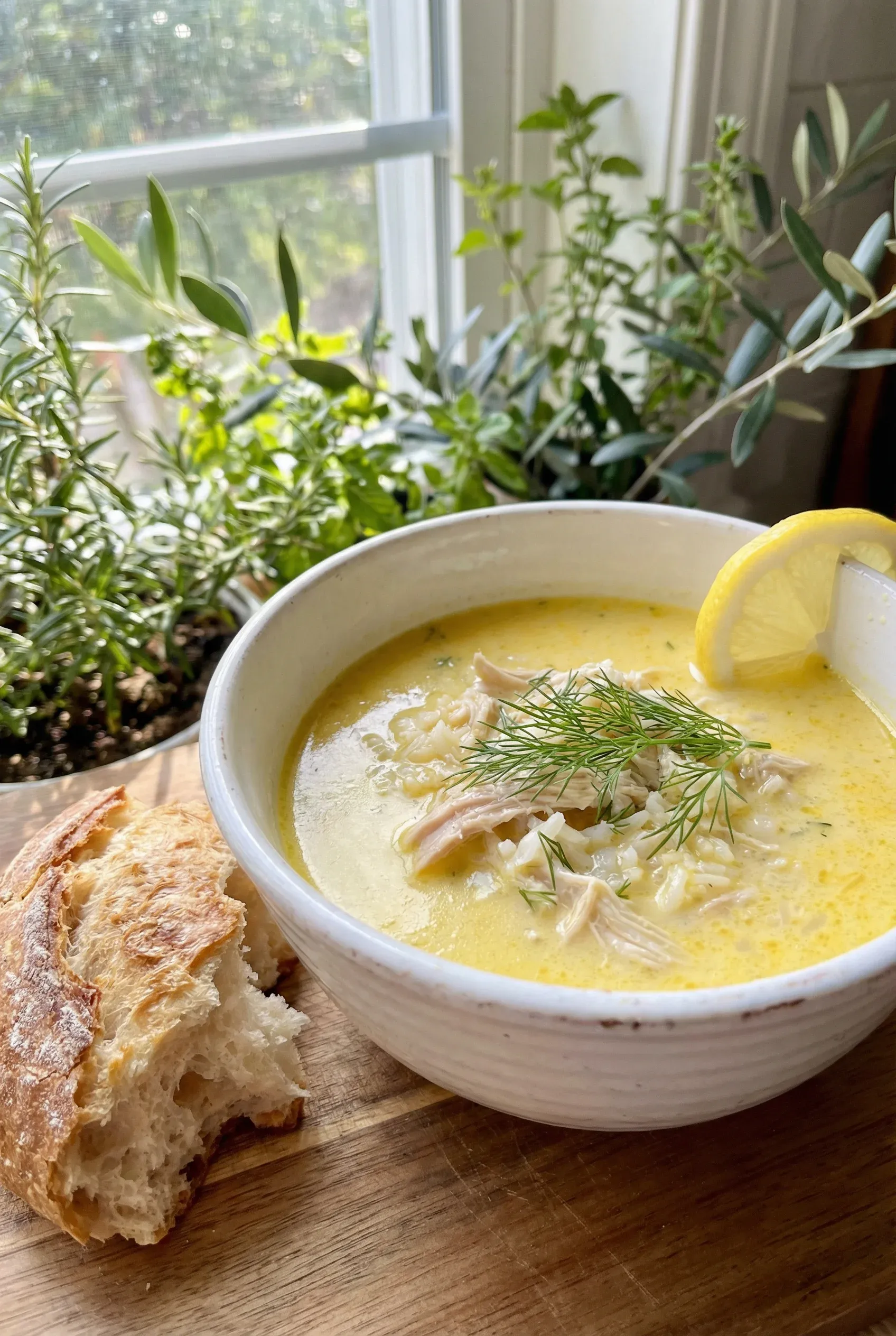
The Story Behind This Recipe
I first tasted avgolemono on a sweltering August afternoon in Athens, which sounds counterintuitive — who eats hot soup in the Greek summer? But the cook at a tiny taverna near Monastiraki Square ladled out a bowl of this silky, lemony broth and insisted I try it. One spoonful and I understood. This wasn’t heavy, stodgy soup. It was light, bright, and impossibly creamy without a drop of cream. The egg and lemon did all the work, creating a texture that felt like velvet on the tongue. I sat there in the heat, finished the entire bowl, and immediately asked for the recipe. The cook laughed and said there was no recipe — just eggs, lemons, good broth, and patience.
That moment changed how I thought about Mediterranean cooking. I had spent years in Portuguese and Spanish kitchens, where acidity came from vinegar and wine, where richness came from cream or butter. But Greek cooking showed me a different path — the egg-lemon emulsion, a technique that dates back centuries, achieving luxurious body through nothing more than chemistry and careful tempering. When I returned to my restaurant work in Lisbon, I started incorporating avgolemono principles into my own dishes. A little egg and lemon stirred into a fish stew. A lighter hand with cream. The Greek influence quietly reshaped my Portuguese cooking in ways my guests could taste but couldn’t quite name.
This recipe is pure Mediterranean simplicity — a handful of humble ingredients transformed into something far greater than the sum of their parts. You make a proper chicken broth from scratch, cook rice in it until tender, and then stir in a frothy emulsion of eggs and lemon juice that turns the whole pot into liquid gold. No fancy equipment. No obscure ingredients. Just technique, timing, and the freshest lemons you can find. It is the kind of recipe I write about in “The Mediterranean Table” — food that reminds you that the best dishes are rarely the most complicated ones.
Before You Start
A few things that will make all the difference:
- Bring your eggs to room temperature. Cold eggs are far more likely to curdle when they meet the hot broth. Pull them out of the fridge at least 30 minutes before you start cooking. This is non-negotiable for successful tempering.
- Use freshly squeezed lemon juice only. Bottled lemon juice has a flat, metallic taste that will ruin this soup. You need the bright, complex acidity that only fresh lemons provide. Roll them on the counter with your palm before juicing to get maximum yield.
- Choose the right rice. Short-grain or medium-grain rice (Arborio, Calrose, or Egyptian rice) releases starch as it cooks, which contributes to the soup’s body. Long-grain rice like basmati or jasmine won’t give you the same creamy result and will add unwanted floral aromas.
- Understand the tempering process before you begin. Tempering means gradually raising the temperature of the egg mixture by whisking in small amounts of hot broth. This is the single most important technique in this recipe. Read Step 4 carefully before you start cooking.
- Never boil the soup after adding the egg mixture. Once the avgolemono goes in, the soup must stay below a simmer. Boiling will cause the eggs to curdle into scrambled bits floating in your broth.
Instructions
Step 1: Build the Broth
Place the whole chicken (or chicken thighs) in a large stockpot or Dutch oven. Add 10 cups of cold water — starting with cold water extracts more flavor from the bones and produces a clearer broth. Add the carrots, celery, quartered onion, bay leaves, peppercorns, and 1 tablespoon of kosher salt.
Bring to a boil over high heat, then immediately reduce to a gentle simmer — you want lazy bubbles breaking the surface, not a rolling boil. A hard boil will make the broth cloudy and can toughen the chicken.
Skim any foam or scum that rises to the surface during the first 5–10 minutes. This is protein from the chicken and removing it gives you a cleaner, more refined broth.
Simmer partially covered for 25–30 minutes if using thighs, or 45–50 minutes if using a whole chicken, until the meat is cooked through and reaches an internal temperature of 165°F (74°C). The meat should pull away from the bone easily.
Step 2: Prepare the Chicken and Strain the Broth
Using tongs or a slotted spoon, carefully remove the chicken from the pot and transfer it to a cutting board. Let it cool for 10 minutes until you can handle it comfortably.
While the chicken cools, strain the broth through a fine-mesh sieve into a clean pot, discarding the vegetables, bay leaves, and peppercorns. You should have approximately 8 cups of rich, golden broth. If you have less, add water to reach 8 cups. Taste and adjust the salt — it should be well-seasoned but not overly salty, as the lemon juice will brighten everything later.
Shred or chop the chicken into bite-sized pieces, discarding the skin and bones. Set the chicken aside.
Step 3: Cook the Rice
Bring the strained broth back to a boil over medium-high heat. Add the rice, stir once to prevent sticking, then reduce the heat to medium-low. Simmer uncovered for 15–18 minutes, stirring occasionally, until the rice is tender but still has a slight bite. The rice will continue to absorb liquid as the soup sits, so don’t overcook it.
Once the rice is tender, add the shredded chicken back to the pot and stir to combine. Remove the pot from the heat entirely. This is critical — you need the broth to stop actively simmering before you add the egg-lemon mixture.
Step 4: Temper the Eggs (The Key Step)
While the rice cooks, prepare the avgolemono sauce. Separate the eggs, placing the whites in a medium bowl and the yolks in a small bowl.
Using a whisk or hand mixer, beat the egg whites until they are frothy and foamy — about 1–2 minutes by hand, 30 seconds with a mixer. You’re not looking for stiff peaks, just a light foam with small bubbles. This step is traditional and creates a more stable emulsion that resists curdling.
Add the egg yolks to the whites and whisk until fully combined and uniform in color. Then, while whisking constantly, slowly pour in the lemon juice in a thin stream. The mixture should be pale yellow, smooth, and slightly frothy.
Now for the tempering: with the pot off the heat, take a ladle of hot broth (about 1/2 cup) and add it to the egg-lemon mixture one thin stream at a time, whisking constantly and vigorously. This slowly raises the temperature of the eggs without cooking them. Repeat with a second ladle of broth, then a third. By now, the egg mixture should feel warm to the touch. This entire process should take about 90 seconds — rushing it is how you end up with egg drop soup instead of avgolemono.
Step 5: Combine and Finish
With the pot still off the heat, slowly pour the tempered egg-lemon mixture into the soup while stirring constantly in one direction with a wooden spoon or silicone spatula. Keep stirring for a full 60 seconds as the soup transforms — you’ll see it turn from a clear golden broth to a creamy, opaque, pale yellow. The texture should be silky and slightly thickened, coating the back of a spoon.
Add the lemon zest and stir to incorporate. Season with white pepper and additional salt to taste. White pepper is traditional here because it doesn’t leave visible specks in the pale soup, but black pepper works fine if that’s what you have.
If the soup needs gentle reheating, place it over the lowest possible heat for 2–3 minutes, stirring constantly. The temperature should never exceed 160°F (71°C) — if you see any wisps of steam, remove it from the heat immediately. Never let it boil.
Step 6: Serve
Ladle the soup into warm bowls. Garnish each serving with a generous pinch of fresh chopped dill and serve with lemon wedges on the side for those who want an extra burst of citrus. A slice of warm, crusty bread alongside is traditional and, in my opinion, mandatory.
Serve immediately — avgolemono is at its absolute best the moment it’s made, when the texture is at its silkiest and the lemon flavor is brightest.
Ingredient Substitutions
| Ingredient | Substitute | Notes |
|---|---|---|
| Whole chicken | 2 lbs bone-in thighs, or 6 cups store-bought low-sodium chicken broth | Homemade broth is far superior, but quality store-bought works for a quicker version. Skip Steps 1-2 if using pre-made broth. |
| Short-grain rice | Orzo pasta | A common Greek variation. Use 1 cup orzo and cook for 8–10 minutes. The soup will be slightly less creamy. |
| Eggs (3 large) | 4 egg yolks only | Creates a richer, denser soup. You lose the lightness that the whipped whites provide. |
| Fresh lemon juice | No good substitute | Do not use bottled. If you absolutely must, use 1/4 cup bottled juice plus 1 teaspoon of fresh lemon zest. |
| Fresh dill | Fresh flat-leaf parsley or mint | Parsley is the most neutral swap. Mint adds a fresh twist that’s common in some regions of Greece. |
| White pepper | Black pepper | Purely cosmetic difference — black pepper leaves visible specks in the pale soup. |
| Kosher salt | Fine sea salt (use half the amount) | Kosher salt is less dense; if using fine salt, reduce by 50% and taste as you go. |
Chef’s Tips
- The broth is everything. A weak broth makes a weak avgolemono. If your homemade broth tastes thin, simmer it uncovered for an extra 15–20 minutes to concentrate the flavor before adding the rice. The soup will only be as good as the liquid it’s built on.
- Whisk the whites first. Many recipes skip this step and just beat whole eggs together. Whipping the whites separately until foamy creates a more stable emulsion that’s far more resistant to curdling. It takes an extra 60 seconds and makes a real difference.
- Temperature control is your safety net. If you’re nervous about curdling, use an instant-read thermometer. Keep the soup between 140–160°F (60–71°C) after adding the egg mixture. This range gives you a beautiful, creamy texture with zero risk of scrambling the eggs.
- Add more lemon gradually. Start with 1/3 cup of lemon juice and taste after combining. You can always add more, but you can’t take it away. The soup should be noticeably lemony — that’s the whole point — but not so sour that it makes you pucker.
- Stir in one direction. This sounds like an old wives’ tale, but stirring consistently in one direction while adding the egg mixture creates a smoother emulsion than stirring randomly. The proteins align more uniformly. Greek grandmothers have been right about this all along.
- Don’t skip the resting. Let the finished soup sit off the heat for 3–5 minutes before serving. The flavors meld and the texture settles into its final silky state during this brief rest.
Meal Prep & Storage
- Refrigerator storage: Let the soup cool completely, then transfer to an airtight container. It keeps well in the fridge for up to 3 days. The texture will thicken considerably as it cools — this is normal and expected.
- Reheating: Reheat gently over low heat, stirring constantly. Add a splash of chicken broth or water to thin it back to your desired consistency. Never microwave on high — use 50% power in 1-minute intervals, stirring between each. The goal is to warm it without bringing it anywhere near a boil.
- Freezing: Avgolemono does not freeze well. The egg emulsion tends to break and separate when thawed, resulting in a grainy texture. If you must freeze it, do so before adding the egg-lemon mixture — freeze the chicken-rice broth and make the avgolemono sauce fresh when you reheat.
- Make-ahead strategy: You can make the chicken broth and shred the chicken up to 2 days ahead. Store the broth and chicken separately in the fridge. When ready to serve, bring the broth to a simmer, cook the rice, and proceed with the egg-lemon tempering. This splits the work nicely and gives you fresh avgolemono in about 25 minutes.
- Batch tip: This recipe scales easily. Double the broth and rice, but increase the eggs to 5 (not 6) — the ratio doesn’t need to scale linearly. Taste and adjust the lemon juice.
Pairing Suggestions
- Bread: Warm, crusty sourdough or a traditional Greek village bread (horiatiko psomi) for dunking. The bread is essential for soaking up the last drops of that creamy, lemony broth.
- Salad: A classic Greek salad (horiatiki) with ripe tomatoes, cucumber, red onion, Kalamata olives, and a block of feta. The crisp, tangy salad is the perfect contrast to the warm, silky soup.
- Wine: A chilled Greek Assyrtiko from Santorini, with its bright acidity and mineral notes, mirrors the lemon in the soup beautifully. Alternatively, a crisp Vinho Verde from my native Portugal works wonderfully.
- Olives and cheese: A small plate of Kalamata olives, marinated feta, and a drizzle of good olive oil makes this a complete Mediterranean meal.
Frequently Asked Questions
My soup curdled — can I fix it? If you see small bits of cooked egg floating in the broth, the eggs were shocked by too-high heat. You can rescue a mildly curdled soup by blending it with an immersion blender for 20–30 seconds — it won’t be as silky as properly tempered avgolemono, but it will still taste good and have a pleasant, slightly thicker texture. To prevent this next time, make sure the pot is completely off the heat before tempering, and add the hot broth to the eggs very slowly.
Can I make this soup vegetarian? You can make a vegetarian version using rich vegetable broth, but it won’t taste like traditional avgolemono. The chicken broth provides an essential savory backbone. If you go the vegetable route, use a broth made with roasted vegetables and add a Parmesan rind while simmering for extra depth of flavor. The eggs still provide the signature creamy texture.
Why do you whip the egg whites separately? Whipping the whites until foamy before adding the yolks creates a more stable foam structure that’s far more resistant to curdling when it meets the hot broth. This is a technique used in traditional Greek households and by professional cooks. It adds about a minute of extra work and dramatically improves your chances of a perfectly smooth, silky soup.
Can I use orzo instead of rice? Absolutely — avgolemono with orzo (kritharáki) is a beloved variation throughout Greece. Use about 1 cup of orzo and cook it for 8–10 minutes until al dente. The soup will have a slightly different character — a bit less creamy since orzo doesn’t release as much starch as short-grain rice — but it’s equally delicious and arguably more common in some regions.
How lemony should the soup taste? The soup should be distinctly lemony — that’s the whole identity of avgolemono. It should be bright and tangy but not puckeringly sour. Start with 1/3 cup of lemon juice, taste after combining, and add more a tablespoon at a time until you hit the sweet spot. Keep in mind that the lemon flavor will mellow slightly as the soup sits, so err on the side of slightly more lemon than you think you need.
Is avgolemono served hot or cold? Traditionally, avgolemono is served hot, though it is also excellent at room temperature during warm weather — which is exactly how I first encountered it in Athens. If serving at room temperature, the soup will be thicker and the lemon flavor will be more pronounced. I don’t recommend serving it cold from the fridge, as the texture becomes too thick and the flavors are muted.