
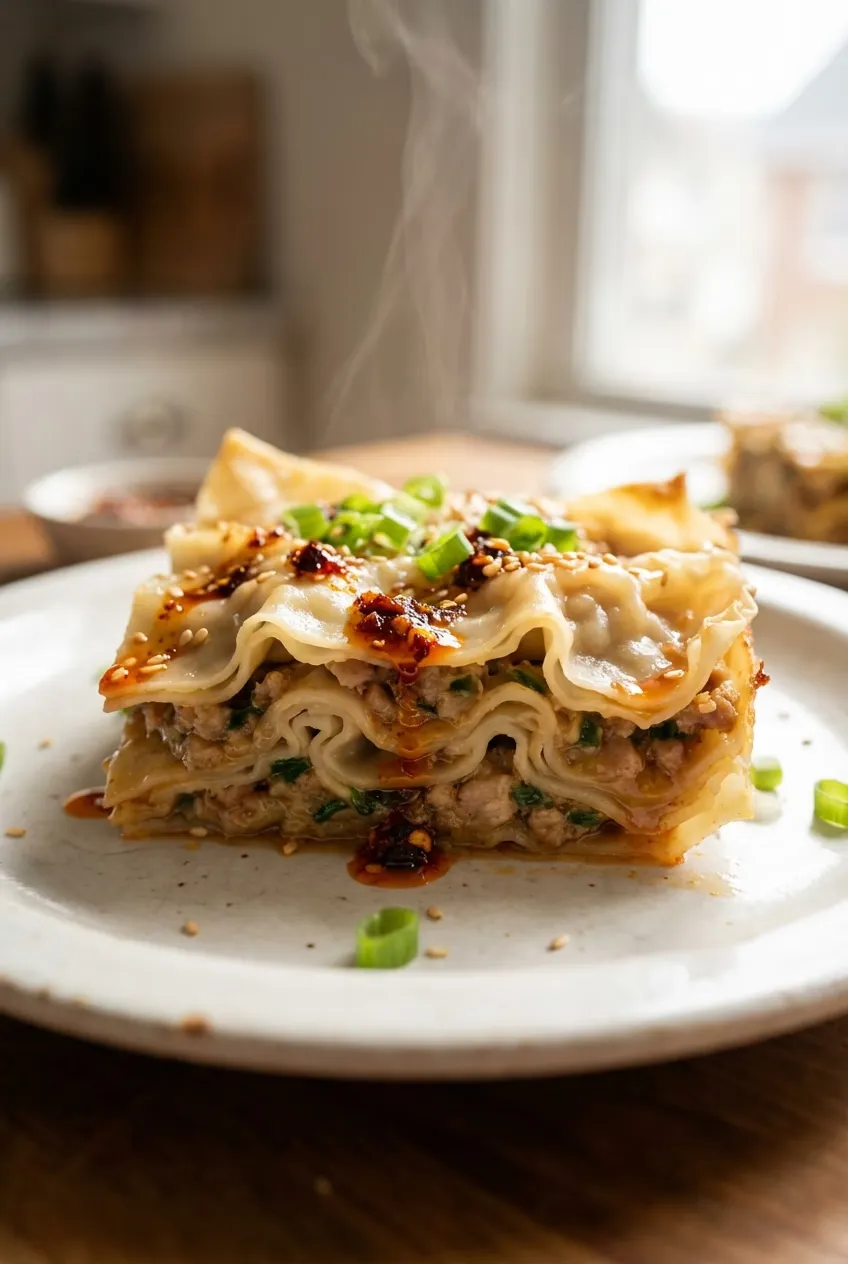
The Story Behind This Recipe
I still remember the first time someone showed me a TikTok of dumpling lasagna. I was standing in the back kitchen at Jade Garden in San Francisco, elbow-deep in dumpling prep for the weekend dim sum rush, and my sous chef held up his phone with this look like he’d just seen someone commit a culinary crime. Layers of wonton wrappers and filling, stacked in a ramekin, steamed like a casserole. No pleating. No folding. No pinching. I laughed at first — I’d spent years perfecting my pleat technique, twenty-two folds per dumpling, and here was the internet saying none of that mattered.
But then I made one. And I’ll be honest with you — it was absolutely delicious. The wonton wrappers, freed from their individual pouches, turned silky and almost translucent, soaking up the pork juices and chicken stock like sheets of fresh pasta. The filling stayed juicy because it was insulated between those layers instead of exposed to direct steam. And the whole thing came together in a fraction of the time. I called my mother in Chinatown that night and told her about it. She said, “James, your grandmother made something like this in Guangzhou sixty years ago. You think TikTok invented layered dumplings?” She had a point.
What I’ve done is take that viral concept and apply everything I know about building real dumpling flavor. The baking soda trick for tender meat. Shaoxing wine for depth. Shiitake mushrooms for umami. Properly squeezed cabbage so the layers don’t get waterlogged. This isn’t a shortcut version of dumplings — it’s a different format that happens to be easier and, in some ways, even more satisfying. The textures are incredible: silky wrapper, juicy pork, tender cabbage, all held together by a rich, savory broth that concentrates as it steams. My grandmother would approve.
Before You Start
- Squeeze the cabbage dry. This is the single most important prep step. After mincing the napa cabbage, put it in a clean kitchen towel and wring out every drop of liquid. Wet cabbage will make the layers soggy and the filling won’t bind properly.
- Use fresh wonton wrappers, not frozen. Fresh wrappers from the refrigerated section (or an Asian grocery) are thinner and more pliable. Frozen ones tend to be thicker and can turn gummy when steamed.
- Set up your steamer before assembling. Get 2 inches of water simmering in your steamer pot so it’s ready the moment your ramekins are assembled. Steaming starts immediately — no waiting around.
- Have your ramekins ready. You’ll need four 8-ounce (3.5-inch wide, 2-inch deep) oven-safe ramekins or small heatproof bowls. Lightly oil the insides so the lasagna unmolds cleanly.
- Mise en place is essential. Mince, dice, and measure everything before you start mixing the filling. Once you begin layering, you want to move quickly and get them into the steamer.
Instructions
Step 1: Prepare the Filling
In a large mixing bowl, combine the ground pork, squeezed-dry napa cabbage, green onion whites, grated ginger, minced garlic, and diced shiitake mushrooms. Add the soy sauce, Shaoxing wine, sesame oil, oyster sauce, white pepper, salt, and baking soda. Using your hands or a fork, mix vigorously in one direction for 2-3 minutes until the mixture becomes sticky and cohesive — you’ll feel it tighten up and start to pull away from the sides of the bowl. This builds the protein structure that keeps the filling juicy and bouncy, just like a proper dumpling. Set aside.
Step 2: Prep the Ramekins and Wonton Wrappers
Lightly brush the inside of four 8-ounce ramekins with sesame oil or neutral cooking spray. Cut or trim your wonton wrappers to roughly fit the diameter of your ramekins — they don’t need to be perfect circles, and slight overlapping is fine. You’ll need about 10-12 wrappers per ramekin depending on how many layers you build.
Step 3: Build the Layers
Working one ramekin at a time, begin layering: spread a heaping spoonful of filling across the bottom, pressing it into an even layer. Lay wonton wrappers on top, overlapping slightly to cover the filling completely. Repeat this pattern — filling, wrappers, filling, wrappers — until the ramekin is nearly full, about 6-8 layers of filling with wrappers in between. End with a final double layer of wonton wrappers on top.
Step 4: Add the Broth
Carefully pour chicken stock over the top of each assembled ramekin. The broth will seep down through the layers, creating steam pockets and adding moisture that transforms the wonton wrappers into silky, translucent sheets during cooking. You’ll hear it gently sizzle as it settles — that’s exactly what you want.
Step 5: Steam
Place the ramekins in a steamer basket set over a pot with 2-3 inches of simmering water. Make sure the water isn’t touching the bottom of the basket. Cover tightly and steam over medium-high heat for 18-20 minutes. The filling should be fully cooked through — if you have an instant-read thermometer, the internal temperature should read 165°F (74°C). The wonton wrappers will look translucent and silky, and the edges will have puffed slightly.
Step 6: Rest and Unmold
Remove the ramekins from the steamer carefully — they’re extremely hot. Let them rest for 3-4 minutes. Run a thin butter knife or offset spatula around the edges, place a plate on top, and flip. The dumpling lasagna should slide out in a neat little tower. If it resists, give the bottom of the ramekin a firm tap.
Step 7: Sauce and Serve
Drizzle each unmolded dumpling lasagna generously with chili crisp oil and black vinegar. Scatter the reserved green onion greens and a pinch of toasted sesame seeds on top. Serve immediately while the layers are still steaming and the wonton wrappers are at peak silkiness. Each person gets their own individual portion — cut into it with a spoon and watch the layers separate like a savory mille-feuille.
Ingredient Substitutions
| Ingredient | Substitute | Notes |
|---|---|---|
| Ground pork | Ground chicken or turkey | Chicken works well but is leaner — add an extra teaspoon of sesame oil to compensate. Turkey can be slightly dry. |
| Napa cabbage | Regular green cabbage or bok choy | Green cabbage is crunchier and takes longer to soften. Bok choy adds a slightly different, more vegetal flavor. |
| Shiitake mushrooms | Cremini or oyster mushrooms | Shiitakes have the deepest umami. Cremini are milder. Oyster mushrooms add a lovely delicate texture. |
| Shaoxing wine | Dry sherry or mirin | Dry sherry is the closest match. Mirin is sweeter — reduce to 2 teaspoons if using. |
| Wonton wrappers | Fresh dumpling wrappers or gyoza skins | Dumpling wrappers are thicker and chewier. Gyoza skins are nearly identical to wonton wrappers and work perfectly. |
| Chili crisp | Sriracha mixed with sesame oil, or sambal oelek | Lao Gan Ma brand chili crisp is the gold standard. Sriracha mixed with a drop of sesame oil works in a pinch but lacks the crunch. |
| Chicken stock | Vegetable broth or dashi | Vegetable broth for a lighter version. Dashi adds Japanese umami depth — both work beautifully. |
Chef’s Tips
- Mix the filling in one direction. This isn’t superstition — it’s protein science. Stirring the meat mixture consistently in one direction develops myosin strands that create a bouncy, cohesive texture. If you stir randomly, the proteins don’t align and the filling falls apart.
- The baking soda makes all the difference. A quarter teaspoon of baking soda raises the pH of the meat, which helps it retain moisture during steaming. The filling stays impossibly juicy instead of drying out and crumbling. Don’t skip it, and don’t add more than specified — too much creates a soapy aftertaste.
- Don’t overfill the ramekins. Leave about a quarter inch of space at the top. The filling expands slightly during steaming, and the broth needs room to move. Overfilled ramekins will overflow and make a mess in your steamer.
- Steam on medium-high, not full blast. Aggressive boiling creates large, violent bubbles that can splash water into the ramekins and make the top layer soggy. A steady, gentle simmer produces consistent steam without the chaos.
- Make them ahead and refrigerate. You can assemble the ramekins up to 24 hours in advance, cover with plastic wrap, and refrigerate. Add 2-3 extra minutes to the steaming time when cooking from cold. The flavors actually meld and improve overnight.
- Try a crispy bottom variation. After unmolding, heat a tablespoon of oil in a non-stick skillet and sear the bottom of each lasagna for 60-90 seconds until golden and crispy. It adds a textural contrast that takes this from great to extraordinary.
Meal Prep & Storage
- Refrigerator storage: Cooked dumpling lasagnas keep in an airtight container in the fridge for up to 4 days. They reheat beautifully.
- Reheating: Re-steam for 5-7 minutes until heated through, or microwave covered with a damp paper towel for 2-3 minutes. The steaming method preserves the silky wrapper texture better.
- Freezing: Assemble uncooked ramekins, wrap tightly in plastic wrap, then foil, and freeze for up to 2 months. Steam directly from frozen for 25-28 minutes — no need to thaw.
- Batch cooking: This recipe scales easily. Double the filling, prep 8 ramekins, and freeze half for future weeknight dinners. The filling mixture also works as a standalone dumpling filling if you want to make traditional dumplings with the leftovers.
Pairing Suggestions
- Tea: A hot pot of jasmine tea cuts through the richness of the pork and complements the ginger beautifully. Oolong works too if you want something with more body.
- Side: A quick cucumber salad — smashed cucumbers tossed with rice vinegar, sesame oil, garlic, and a pinch of sugar. The cold, crisp crunch is the perfect contrast to the warm, silky lasagna.
- Soup: A light egg drop soup with scallions and white pepper rounds out the meal and keeps everything in the same flavor family without competing.
- Beer: A crisp Japanese lager like Asahi or Sapporo. Clean, light, and refreshing against the savory richness of the pork and mushrooms.
Frequently Asked Questions
Can I make this vegetarian? Absolutely. Replace the ground pork with a mixture of extra-firm tofu (crumbled and pressed dry), finely diced mushrooms (a mix of shiitake and oyster works best), and shredded carrots. Keep all the aromatics the same. Use vegetable broth instead of chicken stock. The baking soda trick won’t apply to tofu, but the layers will still be delicious.
Why do my wonton wrappers get gummy? Two common causes: either you’re using too much broth (which oversaturates the wrappers), or you’re using thick dumpling wrappers instead of thin wonton wrappers. Fresh, thin wonton wrappers from the refrigerated section turn silky when steamed. Thick ones turn gummy and doughy. Also make sure you’re not stacking too many wrappers in a single layer — two overlapping is the sweet spot.
Can I bake this instead of steaming? You can, but it’s a different dish. Baking at 375°F (190°C) for 25-30 minutes will cook the filling through, but the wonton wrappers will crisp up rather than turn silky. Some people prefer this — it becomes more like a dumpling casserole with crispy edges. If baking, increase the broth to 1/4 cup per ramekin to prevent drying out.
Do I need a bamboo steamer? No. Any steamer setup works — a bamboo steamer basket, a metal steamer insert, or even a makeshift setup with a wire rack in a pot with a lid. The key is maintaining consistent steam and keeping water from dripping onto the food. If using a metal lid, wrap it in a kitchen towel to absorb condensation.
How do I know when the filling is cooked through? The wonton wrappers on top will look translucent and slightly puffy. If you press the center gently with a spoon, the filling underneath should feel firm, not squishy. An instant-read thermometer inserted into the center should read 165°F (74°C). When in doubt, give it an extra 2 minutes — oversteaming is much more forgiving than understeaming.
Can I use different proteins? Ground chicken and shrimp both work well. For chicken, add an extra teaspoon of sesame oil since it’s leaner. For shrimp, roughly chop 1/2 pound of peeled shrimp and mix with 1/2 pound ground pork for the best texture — all-shrimp filling can be bouncy but lacks the richness of pork fat.