
The Story Behind This Recipe
I remember the exact moment this recipe was born. It was a Sunday afternoon at my old restaurant Jade Garden in San Francisco, and my sous chef Miguel had brought in a container of his grandmother’s birria for staff meal. We heated it up, and the kitchen filled with this incredible aroma — smoky dried chiles, warm cinnamon, braised beef so tender it was falling apart in the broth. I took one spoonful of that consommé and immediately thought: this is ramen broth. The depth, the body, the way the rendered fat created a shimmering layer on the surface — it had the same soul as a tonkotsu that had been simmering for eighteen hours.
I grew up in my family’s restaurant in San Francisco’s Chinatown, and I trained in Cantonese and Japanese techniques at the Culinary Institute of America. I spent time staging at Narisawa in Tokyo, where I learned that the greatest ramen is defined by its broth — the hours of patience, the layering of umami, the balance between richness and clarity. When I tasted Miguel’s birria, I realized that Mexican braising traditions achieve the same thing through a completely different path. Where Japanese ramen builds umami through pork bones and kombu, birria builds it through toasted dried chiles, charred aromatics, and the slow rendering of collagen from beef bones. Different roads, same destination.
That night I made the first batch of birria ramen — braising chuck ribs in a chile adobo, straining the consommé into ramen bowls, adding chewy noodles and the toppings I knew from both traditions. Cilantro and lime from the Mexican side, jammy soft-boiled eggs and sliced scallions from the Japanese side. My team devoured it. Within a week it was on the menu, and within a month it was the most ordered dish we had. This is the recipe that taught me what fusion really means — not a gimmick, but a conversation between two great culinary traditions that have more in common than anyone realized.
Before You Start
- Toast the dried chiles properly. This step unlocks the smoky, complex flavors that define birria. Burnt chiles turn bitter and ruin the entire broth. Watch them carefully — they need only 30-60 seconds per side in a dry skillet.
- Give yourself time. The braise takes 3 to 3.5 hours and cannot be rushed. The collagen in the beef needs low, slow heat to break down into gelatin, which gives the consommé its body. Plan this as a weekend project or start it in the morning for a dinner payoff.
- Cook noodles separately, always. Never cook ramen noodles directly in the birria broth. The starch from the noodles clouds the consommé and makes it gummy. Cook them in a separate pot of boiling water and add them to the bowl at the last moment.
- Prep your toppings before the braise finishes. Dice the onion, slice the radishes, chop the cilantro, cut the limes, and make the soft-boiled eggs while the beef is braising. Everything should be ready to assemble the moment the broth is done.
- Bone-in cuts are essential. The bones contribute collagen and marrow that make the consommé silky and rich. Boneless beef chuck will work in a pinch, but the broth will lack the viscosity and body that makes this dish extraordinary.
Instructions
Step 1: Toast the Dried Chiles
Heat a large dry skillet or comal over medium heat. Add the ancho chiles, guajillo chiles, and chiles de arbol in a single layer. Press them flat against the skillet with a spatula and toast for 30-60 seconds per side until they become fragrant and pliable, with a few dark spots appearing on the skin. You should smell a rich, earthy, slightly smoky aroma — if they start to smell acrid or turn black, they have gone too far. Transfer the toasted chiles immediately to a bowl and cover with 2 cups of boiling water. Let them soak for 15-20 minutes until soft and hydrated.
Step 2: Char the Aromatics
While the chiles soak, place the halved tomatoes, quartered onion, and unpeeled garlic cloves in the same dry skillet over medium-high heat. Cook, turning occasionally, for 8-10 minutes until all surfaces are deeply charred and blistered — the tomatoes should be collapsing, the onion blackened at the edges, and the garlic soft and fragrant when squeezed. This charring develops the Maillard reaction on the vegetables and adds a smoky complexity that no amount of spices alone can replicate. Peel the garlic cloves and set everything aside.
Step 3: Make the Chile Adobo
Drain the softened chiles, reserving 1/2 cup of the soaking liquid. Transfer the chiles to a blender along with the charred tomatoes, charred onion, peeled garlic, reserved soaking liquid, apple cider vinegar, cumin, oregano, coriander, cinnamon, cloves, and black pepper. Blend on high for 60-90 seconds until you have a completely smooth, deep red adobo sauce. It should be thick but pourable — add a splash more soaking liquid if needed. Taste it: the adobo should be complex, smoky, mildly spicy, and slightly sweet from the ancho chiles.
Step 4: Sear the Beef
Pat the beef dry thoroughly with paper towels — this is critical for a good sear. Season generously on all sides with kosher salt. Heat the vegetable oil in a large Dutch oven or heavy-bottomed pot over high heat until the oil shimmers and you see the first wisps of smoke. Working in batches to avoid crowding, sear the beef for 3-4 minutes per side until a deep brown crust develops. You should hear an aggressive sizzle the moment the meat hits the pan — if it is quiet, your pot is not hot enough. Transfer the seared beef to a plate and repeat with the remaining pieces.
Step 5: Braise the Birria
Reduce the heat to medium. Pour the chile adobo sauce into the Dutch oven and cook, stirring and scraping up any browned bits from the bottom, for 2-3 minutes until the sauce darkens slightly and becomes very fragrant. Return the seared beef and any accumulated juices to the pot. Pour in the beef broth — the liquid should nearly cover the meat. Bring to a boil, then immediately reduce the heat to low, cover with a tight-fitting lid, and simmer gently for 3 to 3.5 hours. The birria is done when the beef is completely tender and falls apart easily when pressed with a fork. The consommé should have a rich, deep red color with a layer of rendered fat glistening on the surface.
Step 6: Prepare the Soft-Boiled Eggs
While the birria braises, bring a medium pot of water to a rolling boil. Gently lower the eggs into the water using a slotted spoon. Cook for exactly 7 minutes for a jammy, slightly runny yolk. Immediately transfer the eggs to an ice bath (a bowl of ice water) and let them cool for at least 5 minutes. Peel carefully — the shells should slide off cleanly if the eggs were shocked properly. Cut each egg in half lengthwise just before serving.
Step 7: Shred the Beef and Finish the Consommé
Remove the beef from the pot and transfer to a cutting board. Using two forks, shred the meat into large, rustic pieces, discarding any bones, cartilage, or large pieces of fat. The meat should pull apart effortlessly.
Strain the consommé through a fine-mesh sieve into a clean pot, pressing on any solids to extract maximum flavor. Discard the solids. Taste the strained consommé and adjust the seasoning — you may need more salt. Skim some of the surface fat if you prefer a lighter broth, but leave at least a thin layer; that fat carries enormous flavor and creates the signature sheen of a great birria.
Step 8: Cook the Ramen Noodles
Bring a large pot of water to a rolling boil. Cook the ramen noodles according to the package directions — typically 2-3 minutes for fresh noodles or 4-5 minutes for dried. Drain well and divide the noodles evenly among 6 large bowls.
Step 9: Assemble and Serve
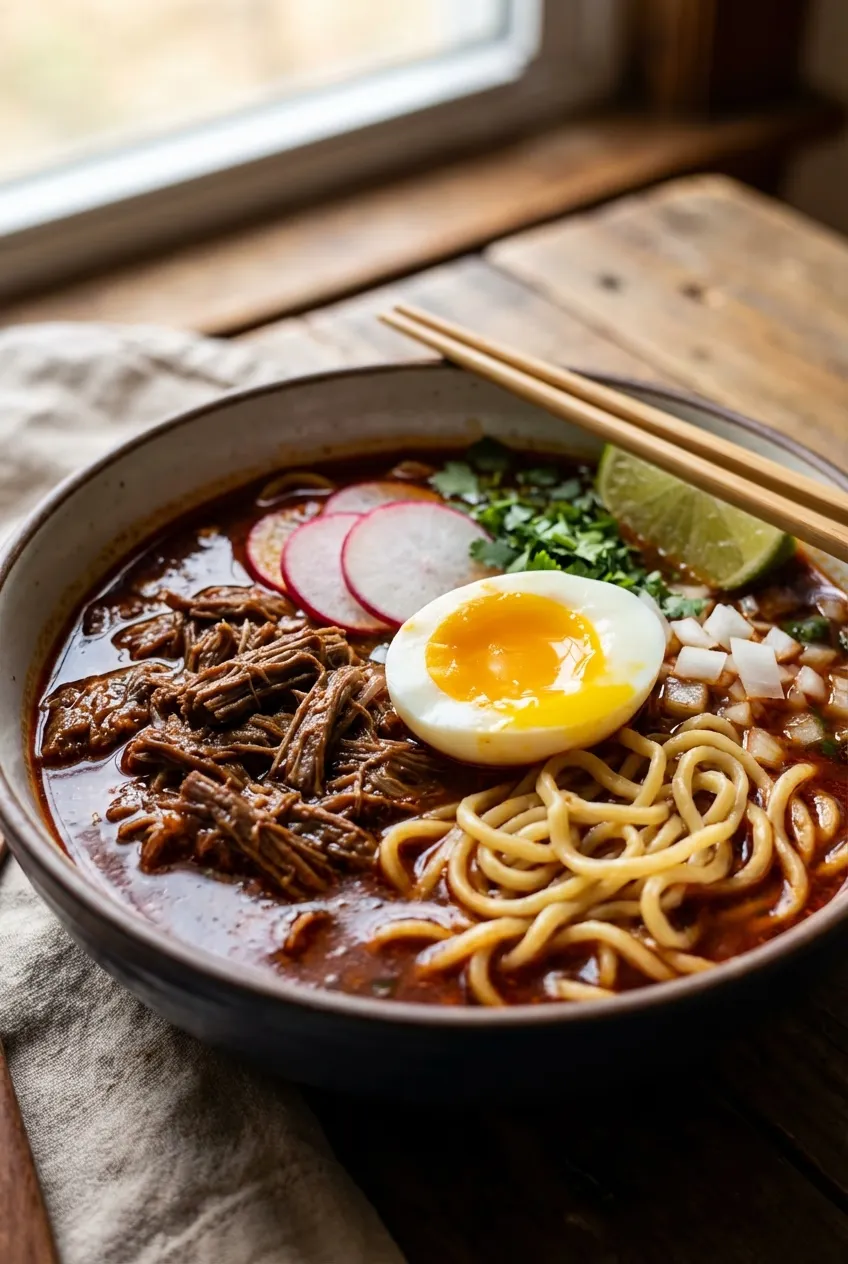
Ladle the hot birria consommé generously over the noodles in each bowl. Top with a mound of shredded beef, two soft-boiled egg halves, sliced radishes, diced white onion, and a generous handful of chopped cilantro. Place a lime wedge on the side of each bowl. Serve immediately with warm corn tortillas on the side for dipping into the consommé — this is the move that ties the Mexican and Japanese traditions together in one incredible meal. Instruct your guests to squeeze the lime over the broth before the first slurp. The acid brightens everything and brings the whole bowl into sharp, vibrant focus.
Ingredient Substitutions
| Ingredient | Substitute | Notes |
|---|---|---|
| Beef chuck short ribs | Beef shank, oxtail, or bone-in chuck roast | Oxtail adds the most gelatin and body to the broth. Bone-in chuck roast is the most affordable option. All work beautifully with long braising. |
| Ancho chiles | Mulato chiles or pasilla chiles | Mulato chiles are the closest — slightly more chocolatey. Pasilla chiles are a bit more herbal. Either works as a 1:1 swap. |
| Guajillo chiles | New Mexico chiles | New Mexico chiles are milder and slightly fruitier. Use the same quantity. |
| Fresh ramen noodles | Dried ramen noodles, udon, or even spaghetti | Fresh noodles have the best chew, but dried ramen works perfectly. In a pinch, spaghetti cooked with a teaspoon of baking soda in the water mimics the alkaline bite of ramen. |
| Mexican oregano | Mediterranean oregano or marjoram | Mexican oregano has a more citrusy, earthy profile. Mediterranean oregano is close enough; marjoram adds a floral sweetness. |
| Apple cider vinegar | White vinegar or lime juice | Both provide the acidity needed to brighten the adobo. Lime juice adds a more distinctly Mexican flavor profile. |
| Beef broth | Chicken broth or water with beef bouillon | Chicken broth lightens the dish slightly. Water with bouillon works but lacks the depth of proper beef broth. |
Chef’s Tips
- The consommé is the soul of this dish. Everything lives or dies by the broth. Give it the full three-plus hours it needs. If the beef is tender after two and a half hours, remove it and keep simmering the broth to concentrate the flavors further. Strain it well — a clear, shimmering consommé with a layer of red-tinted fat on top is what you are aiming for.
- Do not skip the sear on the beef. Those deep brown crusty bits on the meat — and the fond left in the pot — contribute massive flavor to the broth. Searing also renders excess surface fat, which means a cleaner-tasting consommé. Pat the meat extremely dry before it hits the oil; moisture is the enemy of browning.
- Toast your chiles gently. The line between toasted and burnt is razor thin with dried chiles, and burnt chiles make bitter broth. Keep the heat at medium, press them flat so they make full contact, and pull them the moment you smell that warm, earthy, paprika-like fragrance. Thirty seconds too long can ruin the batch.
- The baking soda noodle hack is real. If you cannot find fresh ramen noodles, add one tablespoon of baking soda to the boiling water when cooking dried spaghetti. The alkaline environment changes the protein structure of the pasta, giving it that distinctly chewy, springy, yellow-tinted quality that defines ramen noodles. Rinse well after cooking.
- Make this on a Saturday, eat all week. The birria consommé and shredded beef improve dramatically over the next 3-4 days in the fridge. The flavors deepen, the gelatin sets into a rich jelly that melts back into liquid gold when reheated. Cook the noodles fresh each time you serve it.
- Serve tortillas on the side, always. Dipping warm corn tortillas into the birria consommé is the bridge between the Mexican and Japanese sides of this dish. It sounds like a small detail, but it completes the experience.
Meal Prep & Storage
- Consommé and beef: Store separately in airtight containers in the fridge for up to 5 days. The consommé will set into a firm, red-tinted jelly when cold — this is a sign of excellent gelatin extraction and means your broth has incredible body. Reheat gently on the stovetop.
- Noodles: Cook fresh each time you serve. Cooked ramen noodles stored in broth turn mushy and absorb all the liquid. This is the one component that does not store well.
- Soft-boiled eggs: Peeled eggs can be stored in the fridge for up to 3 days submerged in a container of birria consommé. They absorb the chile flavors and turn into an incredible marinated egg — similar to the Japanese ajitsuke tamago technique but with a Mexican twist.
- Freezing: The consommé and shredded beef freeze beautifully together for up to 3 months. Thaw overnight in the fridge and reheat on the stovetop. Add fresh noodles, eggs, and toppings when ready to serve.
- Batch cooking: This recipe doubles easily. Use a larger pot or split between two Dutch ovens. A double batch feeds a crowd or provides a full week of lunches.
Pairing Suggestions
- Beer: A dark Mexican lager like Negra Modelo or a Japanese Sapporo Black Label. Both have enough malt character to stand up to the rich, spicy broth without overwhelming the complex chile flavors.
- Side: Elote-style grilled corn (Mexican street corn with mayo, cotija, chile powder, and lime) is a knockout alongside the ramen. The sweetness and acidity cut through the richness of the broth perfectly.
- Condiment: A small dish of salsa macha (chile oil with fried garlic, peanuts, and sesame) on the table lets people customize their heat level. It also ties into the Asian side of the dish with its sesame and chile oil elements.
- Dessert: A scoop of vanilla or cinnamon ice cream after this meal is all you need. The warmth and spice of the birria is beautifully cooled by something cold and sweet. Or go with tres leches cake for a full Mexican finish.
Frequently Asked Questions
Can I make birria ramen in an Instant Pot or pressure cooker? Absolutely. Sear the beef and make the adobo as described, then pressure cook on high for 45-60 minutes with a natural release. The result is nearly identical to the stovetop braise in a fraction of the time. The only trade-off is slightly less reduction of the broth — you may want to simmer the strained consommé uncovered for 10-15 minutes after pressure cooking to concentrate the flavors.
How spicy is this dish? As written, it has a moderate, warming heat — present but not aggressive. The ancho and guajillo chiles provide rich, smoky flavor with mild heat, while the chiles de arbol bring the actual spice. For a milder version, reduce or omit the chiles de arbol entirely. For more heat, add up to 4 chiles de arbol or stir in a spoonful of chile oil when serving.
Can I use a different protein besides beef? Birria is traditionally made with goat or lamb, and both are outstanding in this preparation. Goat gives the most authentic flavor — look for bone-in goat shoulder at Mexican or halal butcher shops. Lamb shoulder is widely available and has a similarly rich, gamey quality. For a lighter version, bone-in chicken thighs work but reduce the braise time to 1.5 hours.
Why do I need to cook the noodles separately? Ramen noodles release a significant amount of starch as they cook. If you cook them directly in the birria consommé, the starch clouds the broth, thickens it unevenly, and makes it gummy instead of silky. The noodles also continue to absorb liquid as they sit, which means they become bloated and mushy within minutes. Cooking them separately and adding them to the bowl at serving time ensures a clean, clear consommé and noodles with the perfect chewy texture.
What is consommé in the context of birria? In birria, the consommé is the rich, flavorful braising liquid that the meat cooks in — a combination of the chile adobo, beef broth, and the rendered fat and gelatin from the bones. It is the star of the dish. Traditional birria is often served with a cup of consommé on the side for dipping tacos. In this ramen version, the consommé becomes the soup base, thinned slightly to achieve a broth consistency that is ideal for slurping with noodles.
Can I make this ahead for a dinner party? This is one of the best make-ahead dinner party dishes you can prepare. Braise the birria and prepare the consommé up to 3 days ahead. Store the shredded beef and strained consommé in the fridge. When guests arrive, reheat the consommé, cook the noodles, prep the toppings, and assemble the bowls. The last-minute work takes less than 15 minutes, and your guests will think you spent all day in the kitchen.